AN OPEN LETTER CONCERNING THE RECENT COMMUNICATION TO ALL IOOF LODGES FROM THE EXECUTIVE COMMITTEE OF THE SGL
-I-
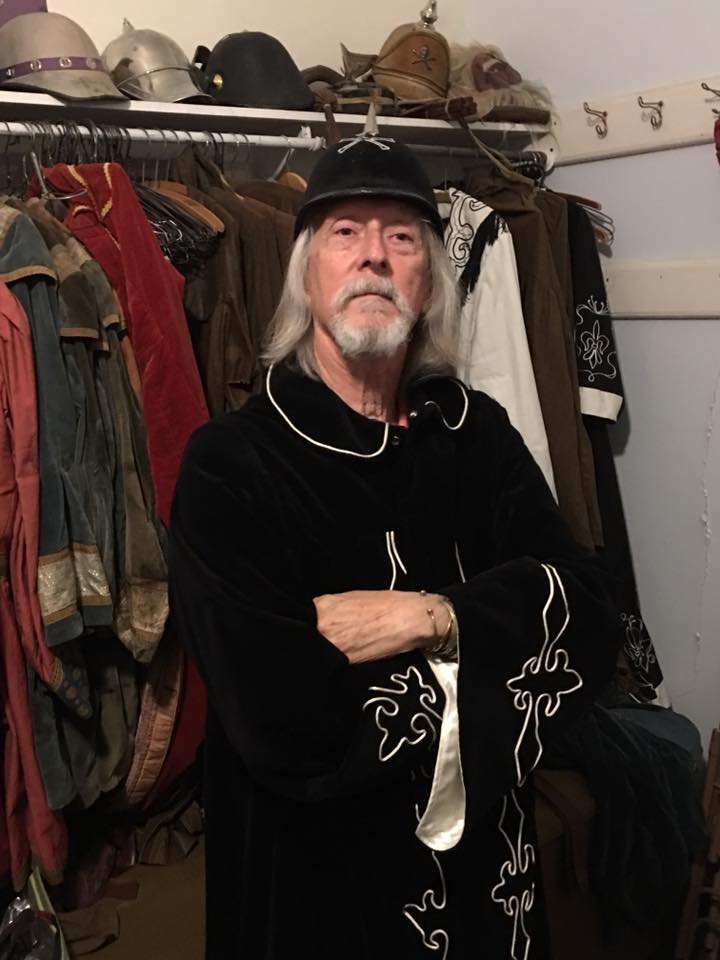
Let me preface these remarks by noting that I am a Past Grand, Past Grand Chaplain, and recipient of the Meritorious Service Jewel. I speak here as solely a concerned member of Odd Fellows and not a representative of any Lodge.
I am a longtime firm believer in the core moral principles of Odd Fellowship and its mission. It is out of reverence for these core principles that I feel compelled to speak some painful truths about the past and present leadership of the IOOF with the hope that my remarks might promote improvements which would help sustain and improve the Order.
-II-
If, in 1963, after giving his I Have a Dream speech in front of the Lincoln Memorial in Washington D.C., Dr. Martin Luther King had applied for membership in the Independent Order of Odd Fellows, he could have been officially rejected simply because he was black. It was only in 1971 that the IOOF officially permitted “non-whites” to become members. (The Grand United Order of Odd Fellows (GUOOF) was formed in 1843 as a fraternal organization for African Americans because, being black, they were excluded from the IOOF.)
If, in 1993, US Supreme Court Justice Ruth Bader Ginsberg had applied for membership to the IOOF she could have been rejected simply because she was female. It was only in 2001 that the IOOF officially permitted women to become members.

I don’t know the exact reasons why the IOOF ultimately changed its mind to allow “non-whites” and women to officially become members. I hope it wasn’t merely a calculated and cynical public relations ploy by the leadership of the IOOF to save itself from mounting, and justifiable, public scorn or, perhaps, to simply avoid a lawsuit.
Rather, I will be charitable and assume that the IOOF was motivated by an increasing realization that denying “non-whites” and women membership was a mere prejudice unjustified by any empirical facts or fundamental moral principles and that to continue on the old course was both immoral and detrimental to the Order.
I try to imagine myself as a member of a lodge at a time when a “non-white” or female applicant was rejected simply because of their race or gender. What would I have done? Kept quiet, ignored the problem and thereby continued my complicity in the injustice? Quit the order thereby severing relations with an organization that engaged in many good works? Or would I have remained in the Order and done my best to reform its unjust policies?
Remaining silent and ignoring the problem would have been cowardice in the face of injustice. How could I maintain a sense of integrity after being a knowing participant in such injustice?
Simply quitting the Order would be to abandon an organization whose core values of Friendship, Love and Truth I earnestly embrace and to do so when the Order is most in need of moral guidance.
I hope I would have chosen to remain an Odd Fellow and attempt reform from within the Order. This seems the only honorable option. While one could be charged with hypocrisy by proclaiming openness and inclusion while at the same time practicing racial and gender discrimination, one might also achieve redemption by acting firmly and openly to end such injustice.
What form would this action take? It would involve speaking out, in a civil and rational manner, to try to get the Order to see that it is acting both immorally and contrary to the fundamental principles of Friendship, Love and Truth. It would involve asking, indeed, insisting, that the leadership of the IOOF justify its prohibition of “non-whites” and women, especially given that such exclusion has nothing whatsoever to do with the content of one’s character which lies at the true core of Odd Fellowship.
Were the Odd Fellows who lobbied for change expelled from the Order or threatened with expulsion by the Sovereign Grand Lodge (SGL)? Were they or their lodges condemned?
Or, rather, were their reasons listened to, seen as having merit and those very reasons become the cause of the changes needed to redress the injustice?
If the latter was the case, then the leadership of the IOOF has in fact changed some long-held rules and traditions because they presumably came to see that things like a person’s race or gender (like their occupation, marital status, or nationality) are irrelevant to the central fundamental question of whether they are honorable persons of good character worthy of being an Odd Fellow.
If the IOOF made changes for these reasons, it should be applauded, for it would be recognizing the implications of its own fundamental core moral principles and its commitment to openness and inclusion. It would be correcting itself by choosing to steer a new course, one which was not only more ethical but also beneficial to the Order.
-III-
A few weeks ago, IOOF lodges received a letter from the present leadership of the IOOF, the Executive Committee of The Sovereign Grand Lodge. The letter stated that the committee has
“observed with profound concern that certain important and obligatory provisions…are not being fully adhered to by some Local Units, Grand Bodies and Jurisdictions”
It goes on to declare that
“All prospective members…are required to give a written or a verbal answer…[to the question] ‘Do you believe in the existence of a Supreme, Intelligent Being, the Creator and Preserver of the Universe? …the applicant’s response to this question must be recorded in ink. Should an applicant answer “no” to this question, they are to be dismissed, as this requirement is non-negotiable and integral to the very nature of our Order. …This same criterion of belief applies to all current members, without exception…If an Applicant or a Member cannot in good conscience profess such a belief, they are prohibited from holding membership in the Independent Order of Odd Fellows.”
The letter’s tone is unmistakable. We are “admonished” that “non-negotiable” obligations are to be followed “without deviation”, “without exception”, responses to be “written in ink”, and so on. Wouldn’t friendship and love dictate that SGL guide its members with benevolent care rather than stern rebukes?
One would think that the “profound concern” felt by the Executive Committee would lead it to ask and answer certain questions.
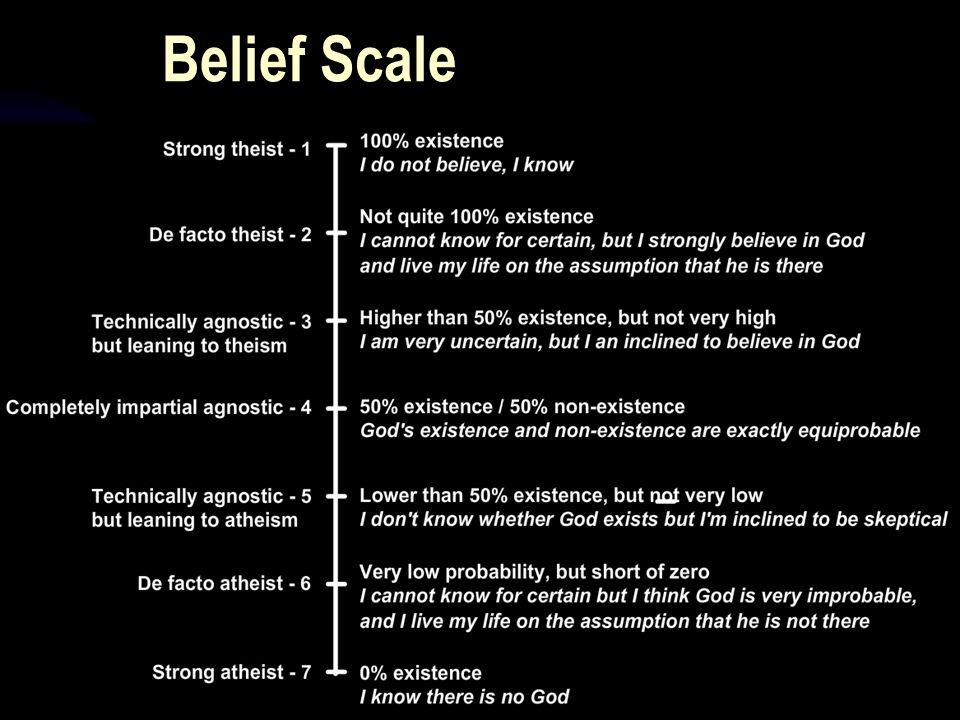
(1) Exactly how does it verify that provisions are not being adhered to? I am aware of no efforts by SGL to actually check up on alleged violations by my Lodge, for example. Wouldn’t basic fairness require this for the SGL to distinguish between gossipy, disgruntled inuendo and credible testimony?
(2) If the provisions of concern are in fact not being adhered to by local Lodges, Grand Bodies, and Jurisdictions, why are they not being adhered to? Is it ignorance? Laziness? Perhaps. Mightn’t it be the case that some of these provisions are viewed by members, at all these levels, the same way prohibitions against “non-whites” and women came to be viewed, as inessential, superfluous, irrelevant and contrary to some fundamental principles of Odd Fellowship? Legitimate concerns such as these should be addressed and discussed, rather than snuffed out as heretical.
Considerations of tone and care aside, it appears that the leadership of the IOOF is ignoring lessons of the past and once again explicitly prohibiting people from becoming (or even remaining) Odd Fellows for reasons which are completely irrelevant to the fundamental moral principles of Odd Fellowship.
The demand by the Executive Committee, that to be an Odd Fellow one must affirm belief in a “Supreme, Intelligent Being, the Creator and Preserver of the Universe”, should be rejected and go the way of similar older demands that one must be white and male.
It is a demand which (1) asks a question which is so vague it is impossible to honestly answer, (2) has no legitimate justification, and (3) is detrimental to the Order.
Consider each of these in turn.
-IV-
- The SGL’s question is impossible to honestly answer.
The question is asked in such a way that it is unclear what one is being asked to affirm.
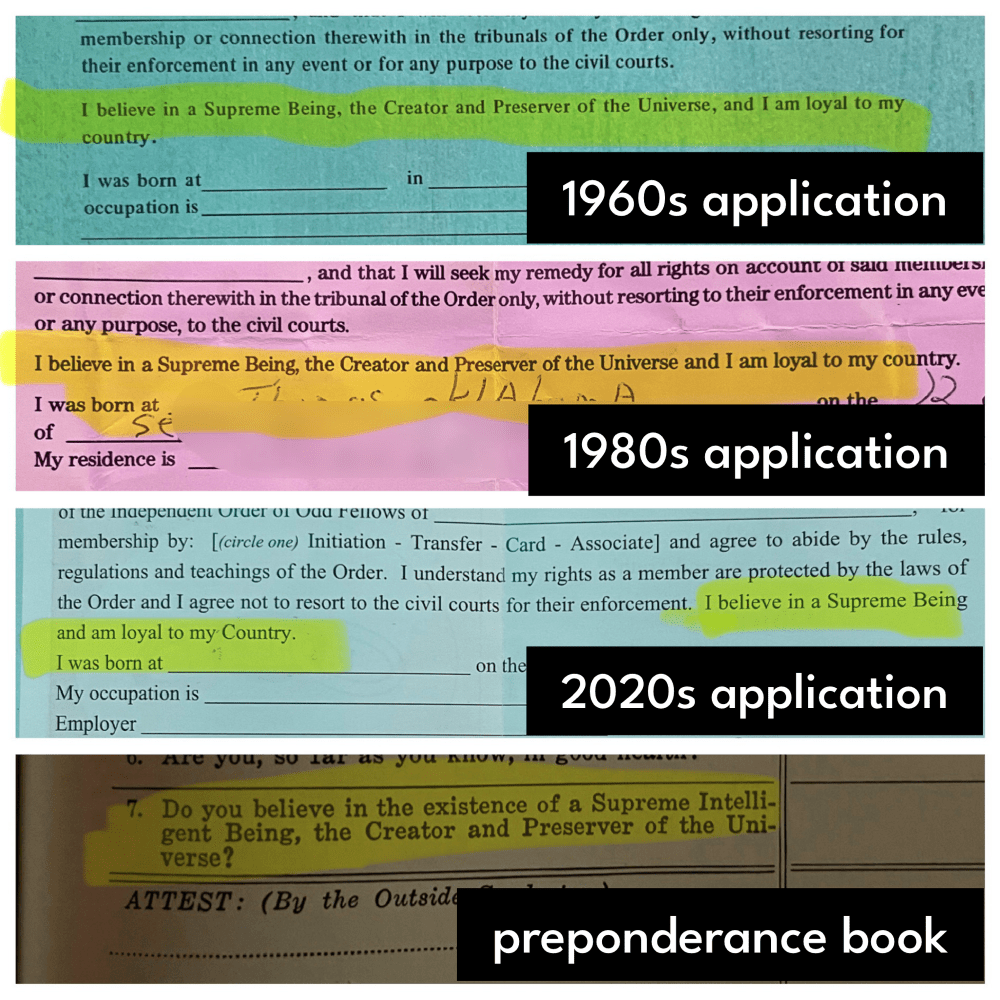
On my original application, I was asked to affirm belief in a “Supreme Being”. Later applications asked applicants to affirm belief in “a Supreme Being, Creator and Preserver of the Universe”. The letter from SGL now demands that applicants and present members affirm belief in “a Supreme, Intelligent Being, Creator and Preserver of the Universe”.
Why is this question being constantly revised? If the revisions are an attempt to offer clarity, much more needs to be said.
Nowhere, for example, does the Executive Committee make mention of whether this “Supreme Being” is good, wise, just, caring, provident, or listens to our prayers. Indeed, no moral attributes of this Supreme Being are ever stated or even alluded to. If an applicant were to affirm belief in an unjust, evil supreme being who is, nonetheless, intelligent and the creator and preserver of the universe, would the SGL deem such affirmation as acceptable for membership in the IOOF?
One might respond that moral perfection is part of the meaning of the term “Supreme Being”. But the term “Supreme Being”, taken by itself and without qualification, is almost completely devoid of specific content. What does the predicate “supreme” mean here? The OED offers almost a dozen different meanings. “Highest in authority, highest in degree, highest in amount, last, final, ultimate” and so on. Which meaning is intended in the question? Highest in authority about what? Highest degree of what? The Executive Committee is silent on the issue.
Miriam Webster defines the term “supreme being” as: “the perfect and all-powerful spirit or being that is worshipped especially by Christians, Jews, and Muslims as the one who created and rules the universe”.
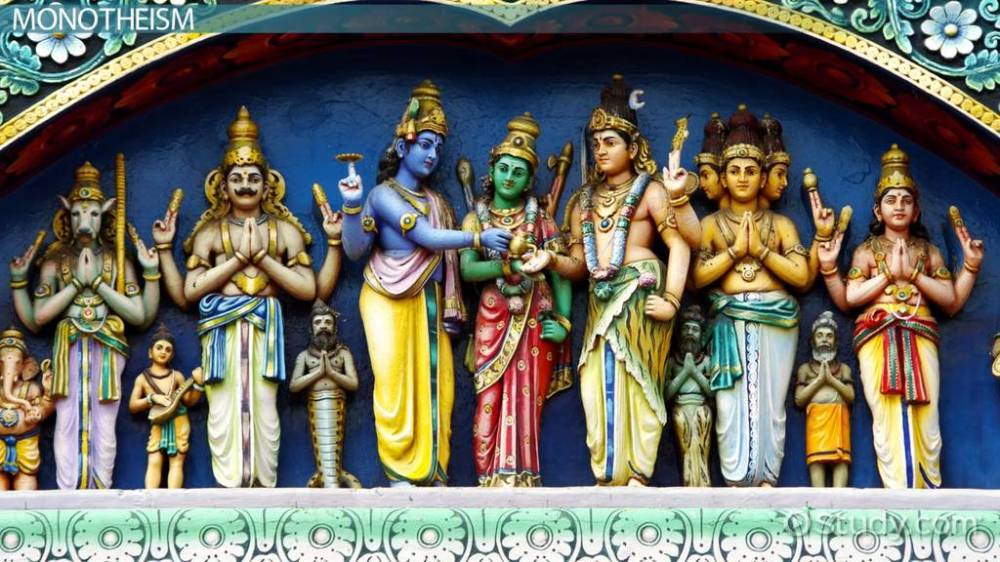
If this is the meaning, then the Executive Committee’s demand would immediately exclude one fourth of the world’s population (Hindus, Buddhists) and would make a mockery of its repeated claim that the IOOF is welcoming to all faiths. Its demand would exclude people of good character who deny that there is a single supreme being (many Eastern religions) or who simply have doubts about who or what, if anything, created the universe (religious, philosophical or scientific agnostics), or those who simply hold a different view about the creation of the universe (most scientists), or those who deny, as unwarranted, the claim that there are any supernatural beings at all, religious or otherwise.
The SGL demands that one affirm belief in an intelligent “creator” of the universe. While there are many theories about the origin (if it has one) of the universe, the view the Executive committee says is “non-negotiable”, is rejected as credible (or even coherent) by virtually all of the scientific textbooks and professors of cosmology at virtually all the greatest institutions of learning in the West. Is it reasonable for the IOOF to demand that one reject the considered views of our current greatest scientific minds in order to become or remain an Odd Fellow?
What does “preserver of the universe” mean? Do atoms and stars need a “supreme being” to keep them in existence? What can that even mean? This harkens back to arcane and outdated views of medieval Scholastic philosophy and theology, rejected as both mistaken and incoherent by the vast majority of modern physicists. Exactly why is it demanded that I believe in divine preservation (whatever it might mean) in order to be an Odd Fellow?
Since the Executive Committee and the SGL are silent about these questions, it is impossible for an applicant, or anyone else for that matter, to know how to honestly answer.
-V-
- The SGL offers no good justification for the demand.
The Executive Committee, in its letter, argues that those who do not affirm belief in the existence of “a Supreme, Intelligent Being, the Creator and Preserver of the Universe” are to be prohibited from membership in the IOOF because there are “objective truths” “integral to the very nature of our Order” “grounded in lessons from the Holy Bible” which have been held by “millions of members over the past 200 years”.
Consider in some detail each of these claims.
“The history of Odd Fellowship is deeply rooted in an affirmative belief in the existence of a Supreme Being…belief in a deity…was an acknowledgement of objective truth as a requirement of membership”
Exactly how is “belief in a deity” an “acknowledgement of objective truth”? What is the relation between belief in a deity and the objective truth that “2+2=4” or that “The earth is a sphere”? Can’t a person believe in objective truth without affirming the existence of a deity?
Perhaps what is being claimed is that belief in a “Supreme Being” is required because this “Supreme Being” is the ultimate source of objective moral values. Perhaps, but the Executive Committee never asserts or even hints at this in its letter.
Even if such an assertion were made, it itself would need justification. It is unlikely that there is any good justification for the, oft repeated, claim that objective morality requires a divine moral lawgiver. Any competent first-year philosophy student would have no problem successfully demonstrating the inadequacy of such a claim.
What “objective truths” about either not believing or being unsure about whether there is a supernatural being that created the universe could possibly justify exclusion from the IOOF? Such a belief has nothing to do with moral character, Friendship, Love or Truth. One can possess or be devoid of moral character independent of race, gender or beliefs about the origin (if it had one) of the universe.
The letter states that belief in a Supreme Being
“is non-negotiable and integral to the very nature of our Order”
What is there about believing that the universe was created by a supernatural being that is “integral to the very nature of our Order”? What does affirming or denying such a belief have to do with Friendship, Love or Truth or any of the core moral principles of Odd Fellowship?
What, perhaps, is integral to our Order is believing in something like an objective universal moral law. i.e. that morality is not just up to the beliefs of a particular person or culture, but, rather, holds across persons and across cultures.
This, it can reasonably be argued, is essential to possessing genuine moral character. But the demand made by the Executive Committee makes absolutely no mention of the supreme being having any moral attributes at all. It only demands belief in an intelligent supreme being who created and preserves the universe. How is insistence on this metaphysical/scientific belief even relevant to moral character or what it means to be a good Odd Fellow?
The IOOF’s desire to have members who are of good moral character is justifiable. It’s demand that members have a particular metaphysical belief about the origin of the universe is not. This is a point that can and should be agreed on by anyone regardless of their faith or lack of faith.
The Executive Committee claims that the Holy Bible is “required to be present and open at every meeting…as a constant and visible reminder of the source for those principles of truth, compassion and charity which are central to our work”.
While the Bible might contain many valuable moral lessons and might, indeed, have been a source of inspiration for early Odd Fellows, it is not the source of the principles of morality itself. The moral lessons worth learning are ones that have force and hold independently of whether they are mentioned in the Bible or not. Some of the Bible’s moral injunctions in the Old Testament are rejected today because they are thought to be immoral, even though the Bible enjoins them. Primacy goes to the moral principles, not the Holy Bible or any other “holy book” for that matter.

This primacy can also be seen in our legal system. No longer is a witness who testifies at a trial required to place their hand on the Holy Bible and affirm that the testimony they are about to give is the truth, the whole truth, and nothing but the truth “so help me God.” The legal system has for the most part discarded these as inessential and vestiges of an earlier time. It recognized that people can give credible sworn testimony even in serious murder cases regardless of their beliefs about Supreme Beings. But the Executive Committee of the IOOF demands such belief simply to be a member.
It is the moral values themselves that the IOOF should insist on and promote, not their alleged source in the Bible. There are many ways one might come to learn moral values. The Bible might reveal some, but there are other sources. Reading the Bible is not essential to apprehending fundamental moral truths.
In its letter the Executive Committee states that
“…altering the foundational principles of our Order is a serious and weighty request…Such a proposal would challenge the core values upon which the Independent Order of Odd Fellows has been built and which millions of members over the past 200 years have willingly agree to uphold. “
What “core values would be challenged” by admitting members who either reject or are just unsure about whether the universe was created by a supernatural being? None, or certainly no core values worth having.
It is true that members of the IOOF have in fact believed for a long time that the Order should exclude those who do not believe in a supreme supernatural creator of the universe. But is that sufficient justification for holding that nonbelievers or doubters ought to be excluded? Just because people have held a belief for hundreds of years is not sufficient justification for thinking that the belief is true. The fact that the IOOF has long prohibited those who reject or doubt the existence of a creator of the universe is not a justification for its continued existence. Rather, it is a cause for reflection and reassessment.
Perhaps one might hold that excluding those who believe in a Supreme Being is a different case from excluding those of a certain race or gender, because being the latter (race or gender) is beyond one’s control, whereas one’s belief about a supreme being is something one chooses and, is, therefore, something one can either freely embrace or reject (unlike one’s race or gender).
But is this true? Aren’t there some beliefs that one can’t help but have, given one’s upbringing or given the information available to them? Can one actually choose to will oneself to believe something that seems inconsistent with all one’s experience, unsupported by any good argument, and for which there appears to be not a shred of evidence? One can say that they believe these things, one can pretend, but can one actually will oneself to believe such things?
Perhaps one’s belief in the existence of a Supreme Being, Creator and Preserver of the universe is of that sort. A person might in good faith, make a sincere, diligent and honest search to find an answer to the question of whether such a being exists, and, finding neither empirical evidence nor good arguments in favor of it, withhold their assent.
This is a rational, principled and moral way to attempt to discover objective truth. It is the way doctors, scientists, historians, indeed all people who are seriously interested in objective truth, proceed. They look at all the available evidence and then attempt to reason their way through to the truth.
Is it fair that such a person, who is of good moral character, should be denied membership in the IOOF because the force of reason keeps them from embracing belief in a supernatural creator? Should the Executive Committee insist that it be a “non-negotiable” demand that such a person be excluded from membership? How is this consistent with basic fairness?
-VI-
The Executive Committee rightly points out that
“It is important for all members to consider: ‘Why would anyone seek to change the foundational values upon which two centuries of member have agreed?’”
Good question.
I am not arguing that one should change the “foundational values” of Odd Fellowship. On the contrary, I am asking that the IOOF live up to its foundational values and focus its attention on values like Friendship, Love and Truth rather than insist on irrelevant questions about the creation of the universe. The change I am lobbying for is that the IOOF abandon its requirement that one believe in a creator deity, just as, in the past, it abandoned its insistence that members be white and male.
Indeed, compare the style of arguments offered in the Executive Committee’s letter with arguments that might have been (and probably were) offered by IOOF leadership in the past concerning race or gender.
Would any good Odd Fellow today be persuaded to retain race and gender prohibitions with claims that such exclusion is justified by “objective truths”; or is “non-negotiable and integral to the very nature of Odd Fellowship”; or is derived from “valuable lessons imparted by the Holy Bible”; or “challenge core Odd Fellows values”: or should be retained because it has been “held by millions of members over the past 150 years”?
Would any Odd Fellow today hold that any of these are a justifiable defense for excluding “non-whites” or women from the Order? Presumably not. Nor are they justifiable defenses for excluding those who disbelieve in or have doubts about a supernatural creator.
What “objective truths” about being “non-white” or female (or having doubts about a supernatural creator) could possibly justify their exclusion?
What is there about being white or male (or believer in a creator) that is “integral to the very nature of our Order”?
What “core values” would be “challenged” by permitting “non-whites” or women (or those who have doubts about a supernatural creator) to join?
The fact that racial and gender discrimination has in fact been held by millions of IOOF members for over 150 years is not sufficient justification for the claim that it ought to be practiced. Just because people have believed something for hundreds of years is not a justification for thinking that what they believe is true or ought to be true. “We’ve always done it that way” is not sufficient. The fact that IOOF prohibitions against “non-whites” and women were long held is not a justification for its continued existence. It is, rather, cause for shame.
Similarly, the fact that belief in a supernatural creator of the universe has been held since the inception of the IOOF is not a sufficient reason for insisting that we continue to exclude those who either do not believe or simply have doubts.
Attempts by the Executive Committee’s letter to justify their demand that one hold certain beliefs about the creation of the universe fail and for a similar reason: they are irrelevant to the fundamental values required to be a good Odd Fellow. If the demand by the Executive Committee were rescinded, the mission of the IOOF and its focus on Friendship, Love and Truth would remain intact and unaltered.
-VII-
- The demand is harmful to our Order.
The IOOF today is struggling just to maintain its membership. It is rapidly becoming a moribund organization, greatly in need of new and vibrant membership to rejuvenate itself. The insistence by the SGL on maintaining and enforcing a prohibition that excludes good people for no justifiable reason is harmful (and perhaps lethal) to our Order. It is not only immoral, but it also practically guarantees the Order’s demise.
Demanding that one affirm belief in a “Supreme Being” is an unnecessary and unwarranted intrusion into one’s private religious beliefs. If the IOOF’s assertion that it is not a religious organization is true, why does the Executive Committee make it a “non-negotiable” demand that to be a member, one must affirm belief in a supernatural supreme being?
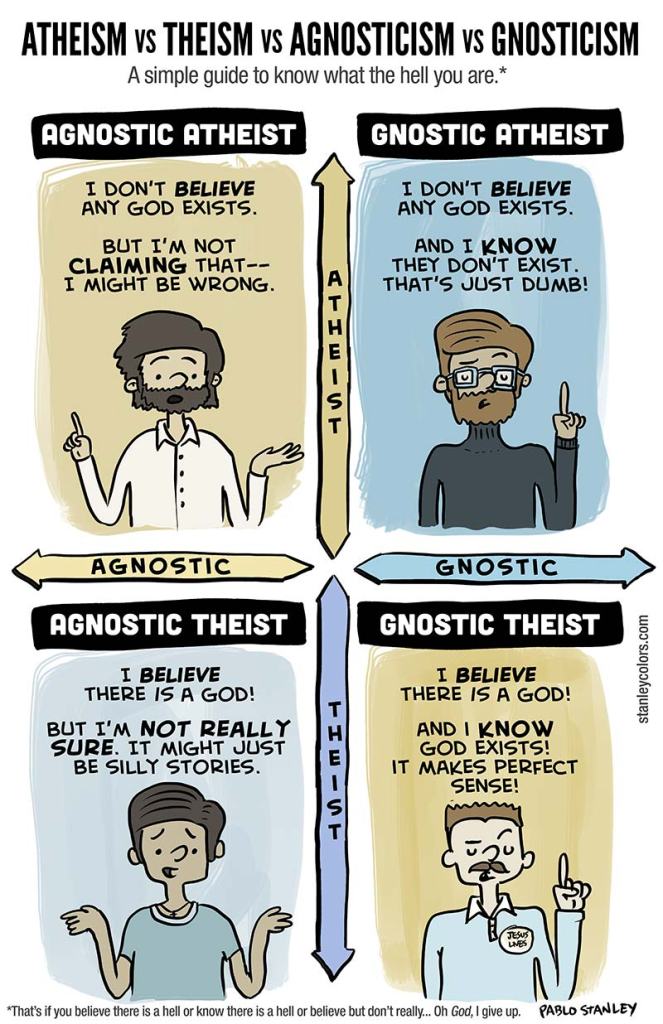
What justifies a non-religious (i.e. secular) organization like the IOOF in its demand that one publicly affirm a particular religious belief in order to become or remain a member? (Belief in a Supreme Intelligent Being who created and preserves the universe can only reasonably be described as a religious belief.)
Even one who firmly adheres to such a belief might feel uneasy at a secular organization insisting that an applicant publicly swear to their private personal religious beliefs. The demand that one do so “in ink” is offensive and off-putting for many members and potential applicants regardless of their religious views. The demand is counterproductive, and inimical to attempts to even maintain, much less increase, IOOF membership.
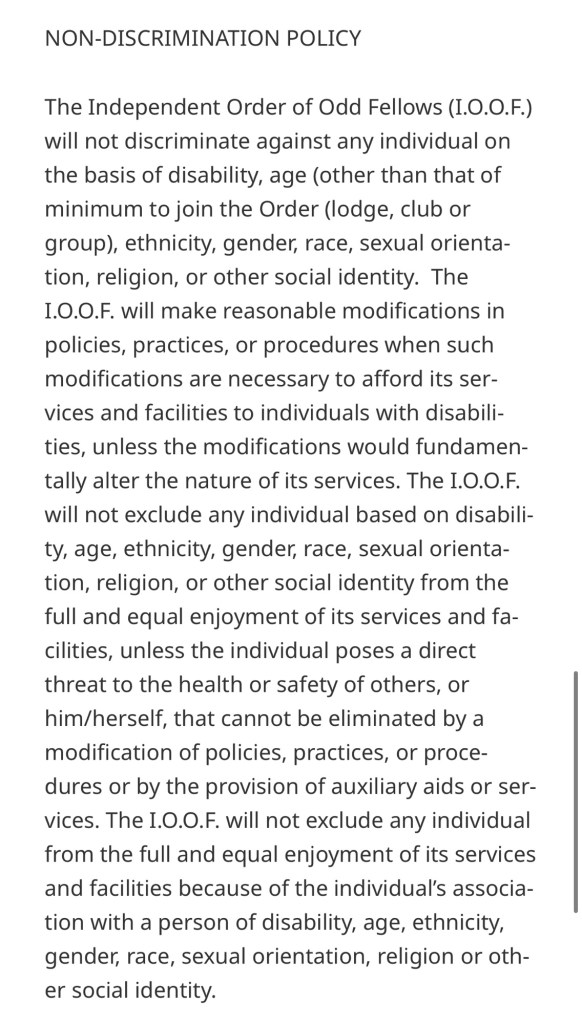
Further, the Executive Committee’s letter claims that, on the one hand, the IOOF
“embraces individuals from all walks of life, irrespective of…religion…”
And that it is
“a diverse and welcoming organization…that embraces individuals…irrespective of…religion”.
On the other hand, it makes it a “non-negotiable” demand that one
“hold fast to their faith in a Supreme Being”
The latter clearly excludes those faiths which would deny a single Supreme Being.
But these claims contradict one another. Which is it? Does the IOOF embrace all religions or only those that believe in a Supreme Being? To many prospective members, all this smacks of hypocrisy and causes many of them to reconsider. They find it hard to reconcile claims that
“the Independent Order of Odd Fellows is neither a religious institution nor a church.”
while being required to publicly affirm that they believe in a Supreme deity and the “Fatherhood of God” before they can attend formal meetings with an open Bible prominently displayed and chaplains intoning the Lord’s prayer.
-VIII-
For all these reasons, I strongly urge the Executive Committee of the SGL to reflect on, reconsider, and rescind its demand that, as a condition of membership, one must affirm belief in a “Supreme Intelligent Being who is the Creator and Preserver of the Universe”.
The SGL has in the past made fundamental changes to membership requirements with respect to race and gender. These changes were not violations of core IOOF values. They were changes in admission requirements which were presumably instigated by those within the Order who, acting in a fraternal way, were true to the IOOF’s core values, were indignant at injustice, and were motivated to improve and elevate both the Order and humankind.
It is time for the IOOF to have the courage to steer a new course and stop excluding honest people of good character who motivated by friendship and love, want to join in the Odd Fellow mission to “visit the sick, relieve the distressed, bury the dead and educate the orphan” simply because they do not share a particular metaphysical belief about the creation of the universe.
Before one attempts a change to the Ritual by submitting formal Legislation and Resolution to The Sovereign Grand Lodge for consideration, it is important to promote an open, civil, and rational discussion among the members and leadership of the IOOF about this serious injustice at the heart of our Order.
I intend this letter to initiate that discussion.
I look forward to hearing thoughtful and detailed answers to the many questions I have posed herein.
Yours in Friendship, Love and Truth
Kurt Roggli
…
Want to more about the Odd Fellows? Ask Me I May Know!
Visit our Facebook page: Heart In Hand

 Heart in Hand
— used AI to craft my point of how IOOF Executive could use gospel, they espouse, to understand whom will judge what makes a righteous person. BTW our missions look like a copy and paste from Matthew 25 —
The Parable of the Sheep and the Goats (Matthew 25:31–46) and the Parable of the Wheat and the Weeds (Matthew 13:24–30, 36–43) are often used by inclusive Christians to argue that God’s judgment is based more on one’s actions and heart than on religious identity alone.
Here’s how each parable contributes to an inclusive view of humanity:
1. The Parable of the Sheep and the Goats – Matthew 25:31–46
Summary:
Jesus describes a final judgment where people are separated like sheep from goats. The sheep are welcomed into eternal life because they fed the hungry, welcomed strangers, clothed the naked, and visited the sick and imprisoned. The goats are condemned for not doing these things.
Key Inclusive Points:
Inclusive takeaway: This parable portrays a judgment based on love in action, not theological knowledge or church membership. It opens the door to the salvation of those who live rightly even if they do not identify as Christians.
2. The Parable of the Wheat and the Weeds (Tares) – Matthew 13:24–30, 36–43
Summary:
A farmer sows good seed (wheat), but an enemy sows weeds among it. When the plants sprout, the servants want to pull up the weeds. The farmer says no—wait until the harvest, when both will be separated: wheat gathered, weeds burned.
Key Inclusive Points:
Inclusive takeaway: This parable encourages humility and restraint in judging others. It supports the idea that some “weeds” (those who appear outside God’s people) may in fact turn out to be “wheat,” and vice versa.
Together, These Parables Suggest:
If we read these parables in light of Romans 2:14–16 (“…they show that the law is written on their hearts…”), the message aligns with an inclusive theology: people who seek truth, act with justice, and live by love may be within God’s grace—even if they do not explicitly identify as Christian.
LikeLike
it’s been a requirement since the founding of the order to believe in God. Typically, those whom do not believe in a creator are selfish in nature and lack a moral compass. This is not always the case, but usually so. The fundamental values of odd fellowship stem from the Bible. If you take away the requirement of belief in a Creator you may as well take away all the degrees. Half the lodges will close or switch over to GUOOF. Which perhaps may be the better option since folks wants to change the very fabric of the order. Go make your own club if you don’t agree with the foundation of IOOF.
LikeLike
Thanks for sharing your perspective. It’s a viewpoint that gets raised whenever these discussions come up, and it’s worth addressing directly with the history we have.
You’re right that a belief in a Supreme Being has been a requirement for a very long time. However, it’s crucial to remember that for most of our Order’s history, being white and male were also considered “foundational” requirements. We correctly chose to abandon those rules because they were unjust and were causing the Order to become an irrelevant relic. The argument that we should keep a rule simply because it’s old is the same one that was used to defend racial and gender exclusion for over a century.
The idea that people without that specific belief are “selfish” or “lack a moral compass” runs counter to the very core of Odd Fellowship. We are taught to judge people on their character and their actions, not their private metaphysical beliefs. Our principles are Friendship, Love, and Truth, values that people of all faiths and no faith can live by.
The most critical point here is about the survival of our lodges. The historical record is crystal clear on this: the single biggest threat to the IOOF wasn’t being too inclusive; it was the opposite. Our profound institutional resistance to change is what caused our membership to decline by over 95%, a far steeper drop than any of our peer organizations. The suggestion that lodges would close or “switch over to GUOOF” if we become more welcoming is especially ironic, given the GUOOF was founded precisely because the IOOF refused to be inclusive in the first place. History shows that lodges don’t die from inclusion; they die from irrelevance.
The call for members to “go make your own club” is the same argument that was used against those who fought to end racial and gender exclusion. The members raising these questions today aren’t trying to destroy the fabric of the Order; they are fighting to save it from the same documented inflexibility that has nearly destroyed it before. They believe the true foundation is Friendship, Love, and Truth, not the exclusionary rules we’ve wrapped around it over the years.
LikeLiked by 1 person
Thank you again for taking the time to write such a thoughtful and heartfelt letter. It takes real courage to speak up about these things, and you’ve put into words something that I think has been on a lot of our minds. Like you, I deeply believe in what this Order stands for, and it’s out of that shared love for our principles that I feel it’s so important to talk honestly about our history.
Your letter bravely points to a difficult truth: the SGL’s current stance doesn’t feel like a one-off issue. It feels like it comes from a long-standing institutional culture of rigidity that has, frankly, nearly destroyed our Order in the past. It’s a culture that has historically resisted change, often until it was far too late.
When we look at our history, the cost of that SGL culture is staggering. It’s not just a feeling; the numbers tell a painful story. While other fraternities declined after the “Golden Age,” our membership plummeted by an astonishing 95%. The historical record is clear that this was not just bad luck; it was a decline overwhelmingly driven by what historians call our own self-inflicted wounds, wounds dealt by that very culture of inflexibility.
That culture has damaged us in very specific ways:
It led us to self-isolation. For 128 years, that culture upheld a “whites-only” rule, and for 150 years, it barred women from full membership. This was a form of “slow institutional suicide,” deliberately cutting ourselves off from the friendship, talent, and energy of the vast majority of the population.
It tarnished our public image. While society was moving forward, that culture of resistance made us look stubbornly stuck in the past. We earned a reputation for being an unwelcoming and anachronistic club, which made it so much harder to attract new people who were understandably wary of our history.
It created a toxic feedback loop. This is the most dangerous part. That insular culture repels new and diverse members, which then causes the remaining membership to become even more isolated and resistant to change. The SGL’s letter, with its rigid tone, feels like a product of that very cycle.
That’s why your letter is so timely. By demanding we enforce a vague and divisive theological test, the SGL seems to be repeating the same historical mistake: prioritizing a rigid, exclusionary rule over the health and growth of the Order.
This brings us to the crucial question you asked: Who do we want to be? Do we want to be defined by a culture of control and dogma, or by our beautiful, universal principles of Friendship, Love, and Truth?
Thank you for holding up a mirror and for having the courage to ask us to look at our own history. It’s a tough conversation, but it’s one this order must have if we want to break from the patterns that have hurt us so badly and build a healthier, more welcoming future for the generations to come.
LikeLiked by 1 person
I really enjoyed the article.
There is no clear reason a belief in a Supreme Being should be a part of Odd Fellowship any longer. Modern times have changed the way many people view their religion.
LikeLiked by 1 person
Do you believe in something higher than yourself? Do you believe in a higher purpose? Do you believe the fraternalism of Friendship, Love , and Truth is the cures to against the ills of ego, hubris, and avarice?This is what it means for me to be an Odd Fellow. This is why I accept brother and sisters of all walks of life in lodge and the Order.
LikeLike
Do you believe in something higher than yourself? Do you believe in a higher purpose? Do you believe the fraternalism of Friendship, Love , and Truth is the cures to against the ills of ego, hubris, and avarice?This is what it means for me to be an Odd Fellow. This is why I accept brother and sisters of all walks of life in lodge and the Order.
LikeLike